BLOCKBUSTERS ON A BUDGET - PART 2
by William C. Martell
Last chapter we found a high concept "event movie" story
where big action occurs OUTSIDE (where it can be done in
miniature) and smaller action occurs INSIDE (on a set). My
"Steel Sharks" script is a huge submarine warfare tale about a
Navy SEAL Team fighting their way off an enemy sub, while F-14
fighter planes, an aircraft carrier, and one of our own subs
attempt to rescue them. A big Tom Clancy-style techno thriller.
This issue we re going to take our concept to script, and I'll
explain some of the techniques used to make our blockbuster on a
budget.
There are two elements which are frequently used to keep low
budget films low budget: Centralized Locations and Confined
Cameos. Using these elements in big budget studio films can
offer tremendous savings both above and below the line. I used
them in "Steel Sharks" to create a giant event film which could
be shot on a $3 million HBO World Premiere budget.
CENTRALIZED LOCATIONS
If you've ever been on a film set, you know the excitement
lasts about 5 minutes... after that it's boring. Most of the day
is spent moving the camera and setting the lights while the stars
sit in their trailers.
Low Budget films have found a partial solution to this. By
having a large portion of the film take place at a central
location, that location can be pre-lit to save time setting up
shots. Most low budget films have a primary location where half
of the film takes place, then several secondary locations. This
reduces down time for crew moves and allows a production to
maximize the number of pages shot per day. A low budget film
averages at least five pages a day, compared to the page or two a
studio film can roll between packing and unpacking the trucks.

On "Steel Sharks" almost a third of the film takes place in
the Control Room of Gary Busey's 688 attack Class submarine. The
periscope area was lighted, and we spent a day shooting all of
the periscope scenes. Because the main lights were set up, a
change in camera angle meant only touch-up work with fill-lights
in the event there were shadows. Without the down time of
re-setting lights, we could zip through a major chunk of the
script. A low budget film might average fifty set ups a day
because the script is DESIGNED to be shot in the most efficient
manner possible.
On "Steel Sharks" the north half of the Control Room could
be lighted, all of those shots done without much down time, then
the south half of the Control Room would be lighted for the next
day. We worked Gary's butt off, and kept him out of his trailer!
Though "Steel Sharks" was directed MOW style in masters and
close ups, nothing prohibits a more creative director from using
the basic lighting set up with more creative camera work. Robert
Rodriguez managed over 50 MOVING CAMERA set ups a day on his Made
For Showtime film "Road Racers".
For your script, you'll need to find a handful of locations
where most of the story will take place. This sounds difficult
at first, but our story is going to take place on an interior
set: A space station, a submarine, a 747, Apollo 13, a speeding
bullet train, etc. These places don't have many sub-locations in
the first place. Our plot isn't going to be like "North By
Northwest", but more like "Silver Streak". "North By Northwest"
travels all over the place. "Silver Streak" takes place in about
3 train cars... and the TRAIN travels all over the place.
"Steel Sharks" was designed with two primary locations,
about 30 pages at each. More than half the script designed for
fast and easy filming. The second location was the CDC (Combat
Direction Center) onboard Billy Dee Williams' aircraft carrier.
Williams plays an Admiral who spends much of the movie
coordinating the rescue operation from satellite transmissions on
wall sized video displays. We shot 25 pages on the CDC set, and
another 5 with Williams on the deck of the aircraft carrier with
the ocean in the background or planes taking off. Because
Williams spends 25 pages on a pre-lighted set, we were able to
zip through his scenes, saving time and money.
The remainder of the script takes place in a variety of
different locations, all in 5 page (one day) increments. Though
another 25 pages of the script takes place on the Iranian
submarine set, it takes place in many different rooms and
passageways of the sub, and contains so much physical action, it
was much slower going. The central location cut out time wasted
with crew moves, but each portion of the submarine set had to be
lighted. I tried to keep it at 5 pages per room, frequently re-
using the same room in a later scene. Other locations included
the Navy SEALs training course, a village in Iran, the building
in Iran where they are keeping the scientist prisoner, and the US
Navy Headquarters in Bahrain.
CONFINED CAMEOS
This is a low budget trick for maximizing your expensive
talent. Let's say you can afford to hire Robert Vaughn for one
day. You want to maximize his screen time, so you confine him to
a location. Instead of spending valuable star time moving the
crew from location A to location B, you make sure EVERY SINGLE
SCENE Robert Vaughn is in takes place at Location A.
Let's say he's the Chief Of Police. You stick him in an
office, light it, and shoot every single scene between the
Renegade Cop and the Chief Of Police: Chewed out, one last
chance, badge and gun taken away, arrested by other cops, finally
convincing the Chief to let him finish the case. These scenes
are weaved through out the film, making it seem like Robert
Vaughn was in the whole thing.
Now take that idea, and multiply it by 6 different locations
and 6 different confined cameos, and you have an ALL STAR CAST
which seems to be in the entire film. Karen Black as the
witness. Martin Landau as the Senator who may be involved.
Michael York as the suspect. Teri Polo as the widow of Renegade
Cop's partner. Stan Shaw as the Renegade Cop's mentor, who owns
a bar. You get the idea.
Each actor works ONE day at ONE location to maximize his/her
screen time.

On "Crash Dive", I created an Admiral character who was
confined to the communications room of the Pentagon for the
entire film. We hired Frederic Forrest to play the role, and
even though it appears as if the Admiral is in the entire film,
in only took a few days to film his scenes.
On "Steel Sharks" I expanded the way confined cameos work.
The producer wanted to hire two names for a week each in
supporting roles. By plugging my confined cameo actors into my
primary locations, I was able to maximize both talent AND sets.
Both Busey and Williams became co-stars in the film, rather than
just supporting roles. Usually one of the primary locations
"belongs" to the lead actor (like Rick's Cafe in "Casablanca", or
Kathy Bates house in Misery ), but in "Steel Sharks" the
primary locations belong to a pair of confined cameo co-stars,
and the lead travels through the secondary locations.
MORE DIET TIPS
Another element in making "Steel Sharks" a blockbuster on a
budget was accuracy. When pitching "Crash Dive", I showed the
producers an article from Variety on how "The Hunt For Red
October" had received US Navy cooperation, which enabled them to
shoot actual Navy maneuvers and war games free of charge. The
Navy requires that the script accurately depict US Navy life,
procedures, and policy. So RESEARCH and ACCURACY in the writing
and development of the script allowed us to shoot on an actual
aircraft carrier on maneuvers in the Pacific. "Steel Sharks" has
REAL F-14 fighter planes, REAL submarines, REAL Navy helicopters
(a great sequence with a SEAL Team in SCUBA gear jumping from a
hovering helicopter into the ocean!), and a REAL aircraft
carrier. Billions of dollars in production value for the cost of
a little research.
When we think of big event films, we usually don't think
much about characterization and quality, and that's a big
mistake. One of the easiest ways to attract name actors to your
project is by giving them a showcase for their talents.
Sylvester Stallone costs $20 million if you re making a
mindless action picture like Daylight , but will do "Copland"
for scale plus ten. Though I don't think a studio could get away
with paying Tom Cruise less than his going rate, if the role
offers him a chance at an Oscar nomination, he might be willing
to live without a couple of his usual perks.
On "Steel Sharks" I made sure all of the major characters
had at least one big dramatic scene. William's Admiral has a
meaty speech about sending men to war and knowing they might not
come back. I'm sure that scene was one of the reasons he signed
for the film. Good characters in a quality story are the most
important (and least expensive) element in attracting actors.
"Steel Sharks" used another money saving method: We reused
the set from "Crash Dive". In the "golden age", movies ALWAYS
reused sets to save money. The battleship from "The Sea Hawk"
was not only used in a half dozen other Warners pirate movies,
but became part of a New York dock set for "Gentleman Jim". This
year we have three summer films which take place on cruise ships:
Speed 2", "Out To Sea", and "Titanic". All three from 20th
Century Fox. All three used DIFFERENT sets! What a waste of
money! The massive multi-million dollar Titanic set sits
unused in Mexico. Why not shoot the other two films on it?
Producers could save millions just by recycling. "The Fifth
Element" has amazing costumes, sets, and creatures. Why not
reuse them in another film? An instant sequel! "Planet Of The
Apes" reused sets and costumes in four subsequent films. Each of
the sequels had the big budget production value of the original
without the cost. The second film passed the lead from the
pricey Charleton Heston, to the more affordable James Franciscus.
Imagine amortizing the sets, costumes, and creatures of "The
Fifth Element" over three films. Though the first film might
cost you $100 million, the three films might have an AVERAGE
budget of $45 million... easily recoverable in today's market.
OTHER PEOPLE'S MONEY (SHOTS)
It's common in low budget films for a writer to wrap a
script around an existing set. These are usually assignments.
Another "golden age" recycling method which is often used to make
blockbusters on a budget is using stock footage. An airplane
battle from one 1930s studio film always pops up in ANOTHER film
by the same studio... Just with a different star in the cockpit
shots. This trick recycles expensive stunts or effects and adds
millions in production value for the cost of a user's fee.

In "Black Thunder" we wanted to augment our (miniature)
Stealth Fighter Plane dogfight sequence with some other big
budget aerial action. We were able to buy actual footage of the
SR-71 Blackbird spy plane in action, and I used it in several
major sequences (putting our hero and his side kick in the
cockpit). I incorporated an air war sequence from another film
into Act 3. Over a dozen F-16s and MiG fighter planes. A huge
air battle with big explosions turned our little film into an
epic war story. All for the cost of the stock footage.
While searching through stock footage for "Black Thunder", I
found an amazing air to air attack and crash sequence from
another film. I've wrapped a story around the sequence and am
pitching it around town.
Studios could save money by using big action stock footage
and amazing FX work from the big budget films of 15-30 years ago
(forgotten today). Thousands of films with expensive large scale
sequences which could be recycled into new films to add that cast
of thousands or amazing explosion sequence. There's a fantastic
sequence in "Airport 75" where a man is lowered on a tether from
one 747 to another... You could wrap a whole new action film
around that scene!
If you re thinking about developing a low budget blockbuster
around stock footage, let me explain how to find a "donor" film.
No one wants to sell valuable footage, so the key is to find
great footage in a worthless film. The donor film has to have
flopped, so that the rights owner will see selling stock footage
as a way to recoup some of his losses. Stock footage from a
popular film is expensive.
Disney made a film four years ago called "Aspen Extreme"
which flopped, but features some amazing avalanche footage. I'm
sure they'd sell it to a producer. Maybe do a variation on "Key
Largo" in a ski lodge, using the avalanche to trap our hero and
his friends with a group of vicious criminals.
Amazing miniature footage can be found in "Raise The
Titanic" from twenty years ago. A half dozen mini-subs exploring
the ocean's floor; plus an amazing sequence where the Titanic is
brought crashing to the surface of the Atlantic, water spraying.
A big budget effect, and most of the shots still look amazing.
Another sequence has the Titanic towed into New York harbor. I
could come up with a dozen sunken ocean liner ideas which could
harvest this footage. Recycling yesterday's big scale events to
boost a reasonable budget film's production values, turning it
into a blockbuster.
It's important to find a new spin on the stock footage. You
couldn't use the "Raise The Titanic" footage for a film about the
Titanic... the rights owner wouldn't let you. But anything else
is fair game. You're only limited by your imagination.
These methods are just the tip of the iceberg. There are
dozens of other tricks used by low budget films to compete with
studio blockbusters. If the studios began using these methods on
a third of their big summer films, they could give the audience
the event films they crave... without going broke in the process.
...FADE OUT
BRAND NEW
OUTLINES & THE THEMATIC!
OUTLINES & THE THEMATIC Blue Book.
ARE YOUR SCENES IN THE RIGHT ORDER?
AND ARE THEY THE RIGHT SCENES?
Your story is like a road trip... but where are you going? What's the best route to get there? What are the best sights to see along the way? Just as you plan a vacation instead of just jump in the car and start driving, it's a good idea to plan your story. An artist does sketches before breaking out the oils, so why shouldn't a writer do the same? This Blue Book looks at various outlining methods used by professional screenwriters like Wesley Strick, Paul Schrader, John August, and others... as well as a guest chapter on novel outlines. Plus a whole section on the Thematic Method of generating scenes and characters and other elements that will be part of your outline. The three stages of writing are: Pre-writing, Writing, and Rewriting... this book looks at that first stage and how to use it to improve your screenplays and novels.
Only $4.99!
ALSO NEW!
DESCRIPTION & VOICE Blue Book!
DESCRIPTION & VOICE Blue Book.
IS HALF OF YOUR STORY IN TROUBLE?
Most screenplays are about a 50/50 split between dialogue and description - which means your description is just as important as your dialogue. It just gets less press because the audience never sees it, the same reason why screenwriters get less press than movie stars. But your story will never get to the audience until readers and development executives read your script... so it is a very important factor. Until the movie is made the screenplay is the movie and must be just as exciting as the movie. So how do you make your screenplay exciting to read? Description is important in a novel as well, and the “audience” does read it... how do we write riveting description?
Only $4.99!
Tips FAQ

My New Script Secrets Newsletter!

NEW BOOKS!
NEW AND HOT!
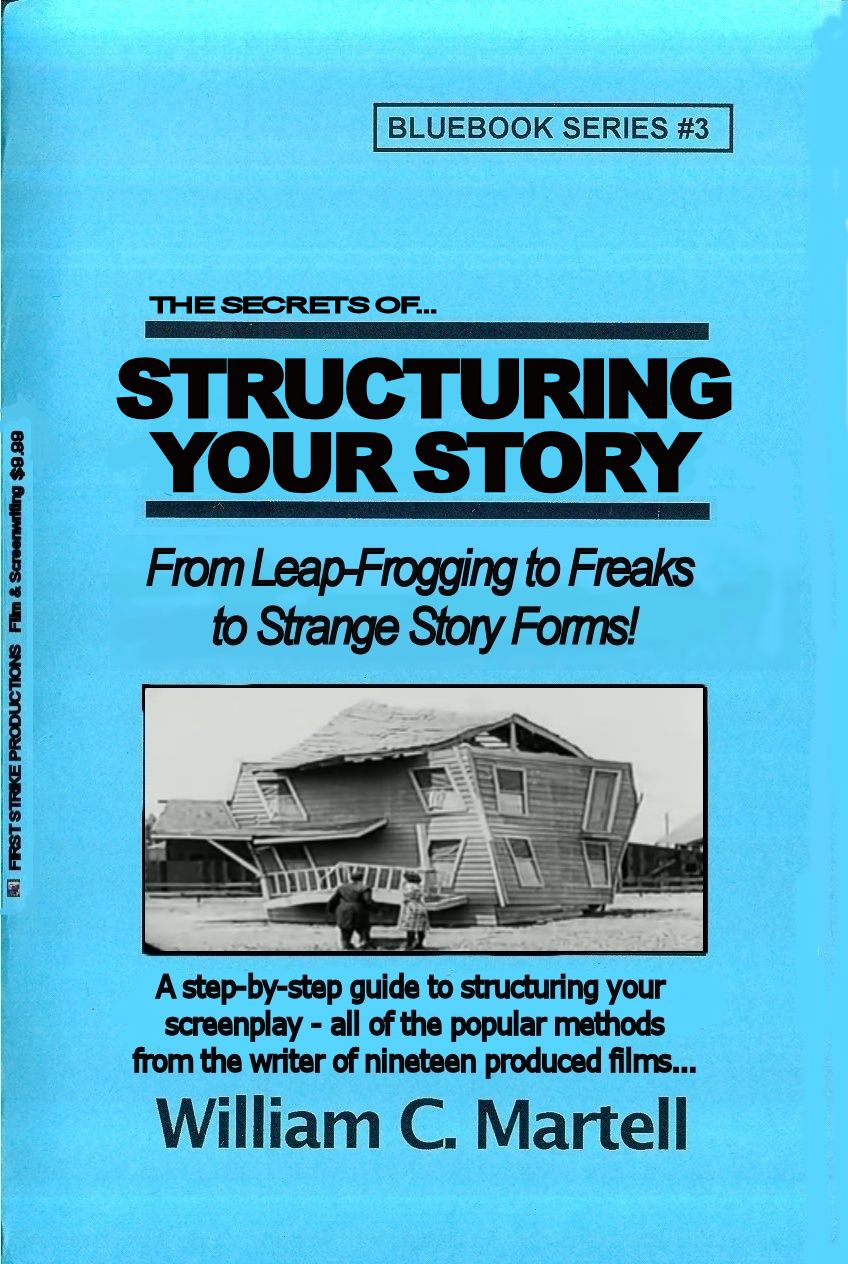
*** STRUCTURING YOUR STORY *** - For Kindle!
William Goldman says the most important single element of any screenplay is structure. It’s the skeleton under the flesh and blood of your story. Without it, you have a spineless, formless, mess... a slug! How do you make sure your structure is strong enough to support your story? How do you prevent your story from becoming a slug? This Blue Book explores different types of popular structures from the basic three act structure to more obscure methods like leap-frogging. We also look at structure as a verb as well as a noun, and techniques for structuring your story for maximum emotional impact. Most of the other books just look at *structure* and ignore the art of *structuring* your story. Techniques to make your story a page turner... instead of a slug!
Only $4.99 - and no postage!
NO KINDLE REQUIRED! Get the *free* app (any device, except your Mr. Coffee) on the order page on Amazon!
LEARN SUSPENSE FROM THE MASTER!
*** HITCHCOCK: MASTERING SUSPENSE *** - For Kindle!
Alfred Hitchcock, who directed 52 movies, was known as the *Master Of Suspense*; but what exactly is suspense and how can *we* master it? How does suspense work? How can *we* create “Hitchcockian” suspense scenes in our screenplays, novels, stories and films?
This book uses seventeen of Hitchcock’s films to show the difference between suspense and surprise, how to use “focus objects” to create suspense, the 20 iconic suspense scenes and situations, how plot twists work, using secrets for suspense, how to use Dread (the cousin of suspense) in horror stories, and dozens of other amazing storytelling lessons. From classics like “Strangers On A Train” and “The Birds” and “Vertigo” and “To Catch A Thief” to older films from the British period like “The 39 Steps” and “The Man Who Knew Too Much” to his hits from the silent era like “The Lodger” (about Jack The Ripper), we’ll look at all of the techniques to create suspense!
Only $5.99

BRAND NEW!
*** THE BOURNE MOVIES
All five "Bourne" movies (including "Legacy" and it's potential sequels) - what are the techniques used to keep the characters and scenes exciting and involving? Reinventing the thriller genre...
or following the "formula"? Five films - each with an interesting experiment! A detailed analysis of each
of the films, the way these thrillers work... as well as a complete list of box office and critical
statistics for each film. This book is great for writers, directors, and just fans of the series.
Only $3.99 - and no postage!

AUDIO CLASS!
NOIR & MYSTERY80 minute CD packed with information on writing Film Noir and Mystery scripts. Using examples from CHINATOWN to OUT OF THE PAST to DOUBLE INDEMNITY you'll learn how to create stories in this dark, twisted genre. How to plant clues, red herrings, suspects, victims, spider women, fallen heroes, the funhouse mirror world of noir supporting characters... and the origins of Film Noir in literature Noir dialogue and how noir endings are different than any other genre. All of the critical elements necessary to write in this critically popular genre.
The Noir & Mystery Class is only $15 (plus $5 S&H). First 20 on Limited Black Disk!
RECESSION SALE! $5 OFF!
IDEAS AND CREATIVITY - 80 minute CD packed with information. Tools to find ideas that are both personal *and* commercial. Hollywood wants scripts with High Concept stories... but not stupid scripts. Developing *intelligent* high concept ideas. How to turn your personal story into a blockbuster - or find your personal story in a high concept idea. Brainstorming and being creative. Ideas and Creativity is $10.00 (plus $5 S&H)
WRITING INDIES - Writing an Indie film? This class covers everything you need to know - from Central Locations to Confined Cameos. Using examples from SWINGERS, THE COOLER, STATION AGENT and others, this 80 minute CD is packed with information. How Indoe films challenge the audience (while mainstream films reassure the audience). Structures, using BOYS DON'T CRY, RUN LOLA RUN, HILARY & JACKIE, and others as example. Writing for a budget, writing for non-actors, getting the most production value out of your budget. Writing Indies is $10.00 (plus $5 S&H)
WRITING HORROR - The essentials of a horror screenplay - what do ROSEMARY'S BABY, NIGHT OF THE LIVING DEAD, THE EXORCIST, BRIDE OF FRANKENSTEIN, THE OTHERS and OPEN WATER have in common? This class will tell you! All of the critical elements necessary to write a script that scares the pants off the audience. Writing Horror is $10.00 (plus $5 S&H).
Click here for more information on CLASS CDs!
THE BOOK THAT STARTED IT ALL!
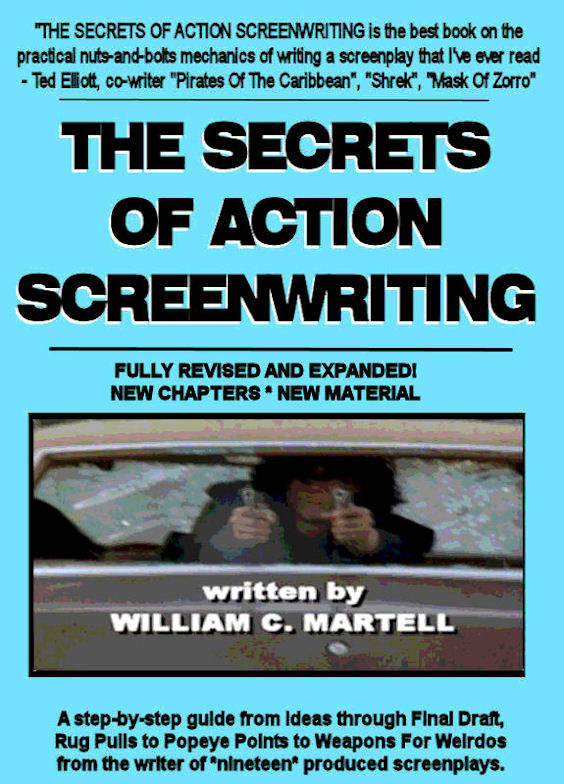
*** THE SECRETS OF ACTION SCREENWRITING *** - For Kindle!
*** THE SECRETS OF ACTION SCREENWRITING *** - For Nook!
Why pay $510 for a used version of the 240 page 2000 version that used to retail for $21.95? (check it out!) when
you can get the NEW EXPANDED VERSION - over 500 pages - for just $9.99? New chapters, New examples, New techniques!
"SECRETS OF ACTION SCREENWRITING is the
best book on the practical nuts-and-bolts mechanics of writing a screenplay I've ever read."
- Ted Elliott, co-writer of MASK OF ZORRO, SHREK, PIRATES OF THE CARIBBEAN and the sequels (with Terry Rossio). (ie; 4 of the top 20 Box Office Hits Of ALL TIME.)
Only $9.99 - and no postage!
READY TO BREAK IN?
NEW!
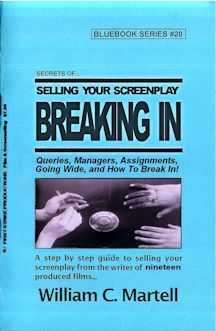
*** BREAKING IN BLUE BOOK *** - For Kindle!
Should really be called the BUSINESS BLUE BOOK because it covers almost everything you will need to
know for your screenwriting career: from thinking like a producer and learning to speak their language,
to query letters and finding a manager or agent, to making connections (at home and in Hollywood) and
networking, to the different kinds of meetings you are will have at Studios, to the difference between
a producer and a studio, to landing an assignment at that meeting and what is required of you when you
are working under contract, to contracts and options and lawyers and... when to run from a deal!
Information you can use *now* to move your career forward! It's all here in the Biggest Blue Book yet!
Print version was 48 pages, Kindle version is over 400 pages!
$4.99 - and no postage!
NO KINDLE REQUIRED! Get the *free* app (any device, except your Mr. Coffee) on the order page on Amazon!
STORY: WELL TOLD!
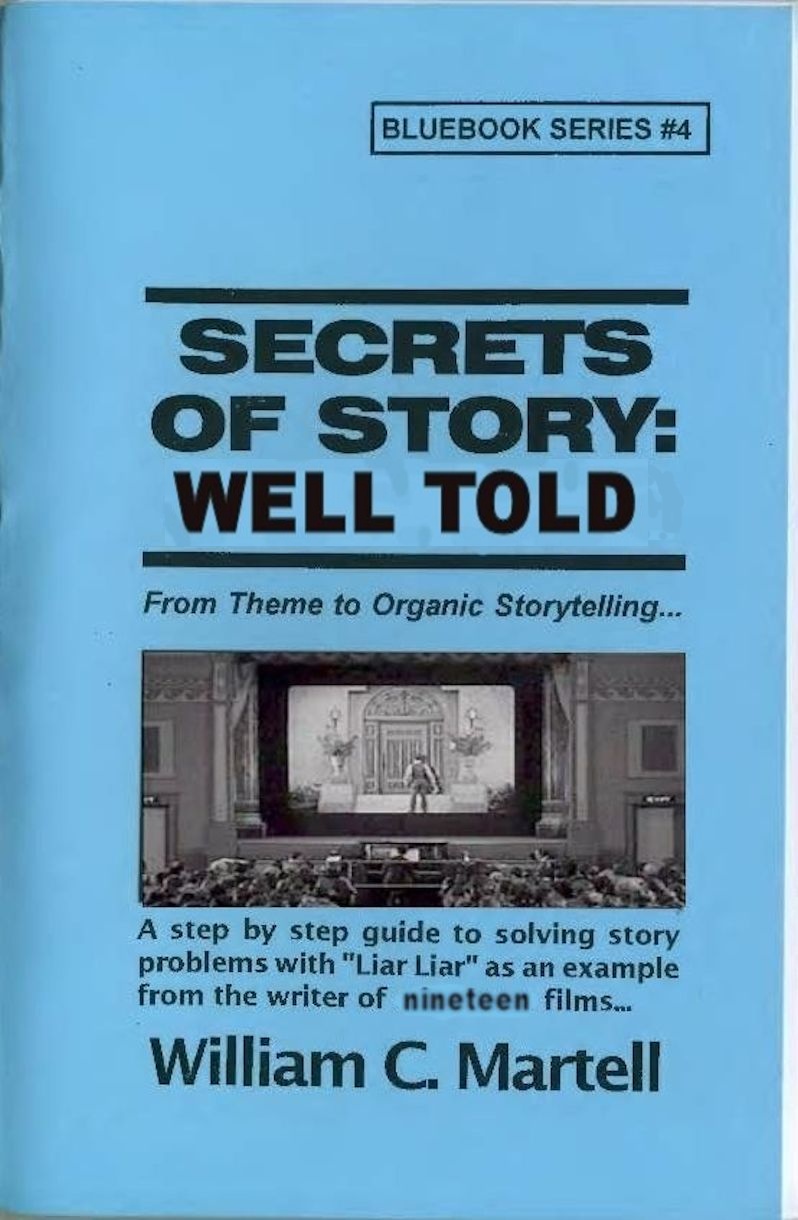
*** STORY: WELL TOLD *** - For Kindle!
This book takes you step-by-step through the construction of a story... and how to tell a story well, why Story always starts with character... but ISN'T character, Breaking Your Story, Irony, Planting Information, Evolving Story, Leaving No Dramatic Stone Unturned, The Three Greek Unities, The Importance Of Stakes, The Thematic Method, and how to create personal stories with blockbuster potential. Ready to tell a story?
Print version was 48 pages, Kindle version is over 85,000 words - 251 pages!
Only $4.99 - and no postage!
MOVIES ARE CHARACTERS!
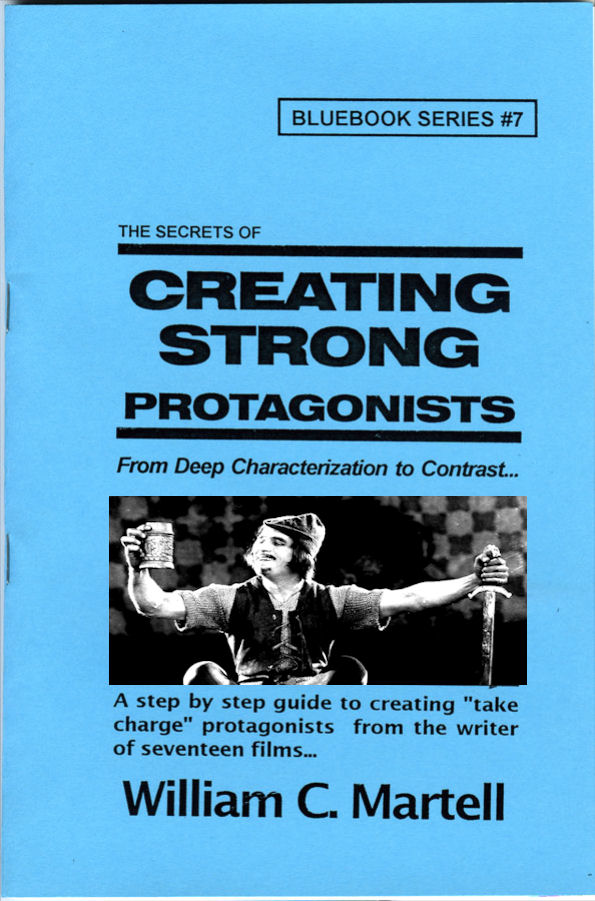
*** CREATING STRONG PROTAGONISTS *** - For Kindle!
*** CREATING STRONG PROTAGONISTS *** - For Nook!
Expanded version with more ways to create interesting protagonists! A step-by-step guide to creating "take charge" protagonists. Screenplays are about characters in conflict... characters in emotional turmoil... Strong three dimensional protagonists who can find solutions to their problems in 110 pages. But how do you create characters like this? How do you turn words into flesh and blood? Character issues, Knowing Who Is The Boss, Tapping into YOUR fears, The Naked Character, Pulp Friction, Man With A Plan, Character Arcs, Avoiding Cliche People, Deep Characterization, Problem Protagonists, 12 Ways To Create Likable Protagonists (even if they are criminals), Active vs. Reactive, The Third Dimension In Character, Relationships, Ensemble Scripts, and much, much more. Print version is 48 pages, Kindle version is once again around 205 pages!
ONLY $4.99 - and no postage!
ACT TWO SOLUTIONS!
*** ACT TWO SECRETS *** - For Kindle!
Expanded version with more techniques to help you through the desert of Act Two! Subjects Include: What Is Act Two? Inside Moves, The 2 Ps: Purpose & Pacing, The 4Ds: Dilemma, Denial, Drama and Decision, Momentum, the Two Act Twos, Subplot Prisms, Deadlines, Drive, Levels Of Conflict, Escalation, When Act Two Begins and When Act Two Ends, Scene Order, Bite Sized Pieces, Common Act Two Issues, Plot Devices For Act Two, and dozens of others. Over 67,000 words (that’s well over 200 pages) of tools and techniques to get you through the desert of Act Two alive!
Print version was 48 pages, Kindle version is well over 200 pages!
ONLY $4.99 - and no postage!
SUBPLOTS?
*** SUPPORTING CHARACTER SECRETS *** - For Kindle! (Exclusive)
Expanded version with more techniques to flesh out your Supporting Characters and make them individuals. Using the hit movie BRIDESMAIDS as well as other comedies like THE HANGOVER and TED and HIGH FIDELITY and
40 YEAR OLD VIRGIN and many other examples we look at ways to make your Supporting Characters come alive on the page.
Print version was 48 pages, Kindle version is around 170 pages!
ONLY $4.99 - and no postage!
Over 240 pages!
*** THE TERMINATOR MOVIES *** - For Kindle!
He's back! The release of "Terminator: Genisys" (now on BluRay) is set to begin a new trilogy in
the Terminator story... 31 years after the first film was released. What draws us to these films about
a cybernetic organism from the future sent back in time? Why is there a new proposed trilogy every few
years? This book looks at all five Terminator movies from a story standpoint - what makes them work
(or not)? What are the techniques used to keep the characters and scenes exciting and involving? How
about those secret story details you may not have noticed? Containing a detailed analysis of each of
the five films so far, this book delves into the way these stories work... as well as a complete list of
box office and critical statistics for each film. This book is great for writers, directors, and just
fans of the series.
ONLY $3.99 - and no postage!

ADVICE FROM 1920!
*** VINTAGE #1: HOW TO WRITE PHOTOPLAYS *** - For Kindle!
***
Screenwriting books have been around as long as films have. This series reprints vintage screenwriting books with a new introduction and history, plus new articles which look at how these lessons from almost 100 years ago apply to today’s screenplays. Anita Loos book is filled with information which still applies.
In addition to the full text of the original book, you get the full screenplay to Miss Loos' hit THE LOVE EXPERT, plus several new articles on the time period and women in Hollywood.
ONLY $2.99 - and no postage!
I WRITE PICTURES!
*** VISUAL STORYTELLING *** - For Kindle! (exclusive)
Show Don't Tell - but *how* do you do that? Here are techniques to tell stories visually! Using Oscar Winning Films and Oscar Nominated Films as our primary examples: from the first Best Picture Winner "Sunrise" (1927) to the Oscar Nominated "The Artist" (which takes place in 1927) with stops along the way Pixar's "Up" and Best Original Screenplay Winner "Breaking Away" (a small indie style drama - told visually) as well as "Witness" and other Oscar Winners as examples... plus RISE OF THE PLANET OF THE APES. Print version is 48 pages, Kindle version is over 200 pages!
ONLY $4.99 - and no postage!
BEST SELLER!
*** YOUR IDEA MACHINE *** - For Kindle!
*** YOUR IDEA MACHINE *** - For Nook!
Expanded version with more ways to find great ideas! Your screenplay is going to begin with an idea. There are good ideas and bad ideas and commercial ideas and personal ideas. But where do you find ideas in the first place? This handbook explores different methods for finding or generating ideas, and combining those ideas into concepts that sell. The Idea Bank, Fifteen Places To Find Ideas, Good Ideas And Bad Ideas, Ideas From Locations And Elements, Keeping Track Of Your Ideas, Idea Theft - What Can You Do? Weird Ways To Connect Ideas, Combing Ideas To Create Concepts, High Concepts - What Are They? Creating The Killer Concept, Substitution - Lion Tamers & Hitmen, Creating Blockbuster Concepts, Magnification And The Matrix, Conflict Within Concept, Concepts With Visual Conflict, Avoiding Episodic Concepts, much more! Print version is 48 pages, Kindle version is over 175 pages!
Only $4.99 - and no postage!
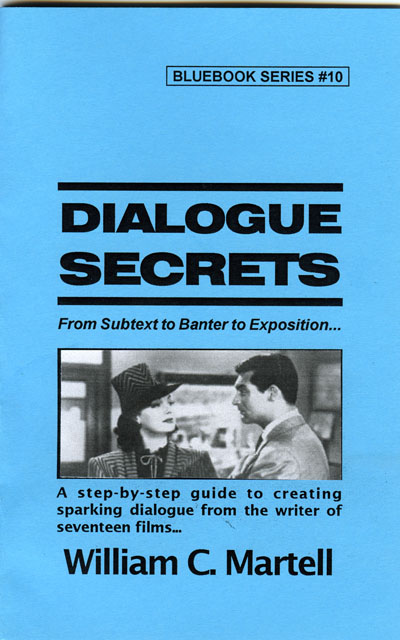
PRO DIALOGUE TECHNIQUES!
*** DIALOGUE SECRETS *** - For Kindle!
*** DIALOGUE SECRETS *** - For Nook!
Expanded version with more ways to create interesting dialogue! How to remove bad dialogue (and what *is* bad dialogue), First Hand Dialogue, Awful Exposition, Realism, 50 Professional Dialogue Techniques you can use *today*, Subtext, Subtitles, Humor, Sizzling Banter, *Anti-Dialogue*, Speeches, and more. Tools you can use to make your dialogue sizzle! Special sections that use dialogue examples from movies as diverse as "Bringing Up Baby", "Psycho", "Double Indemnity", "Notorious", the Oscar nominated "You Can Count On Me", "His Girl Friday", and many more! Print version is 48 pages, Kindle version is over 175 pages!
Only $4.99 - and no postage!

Use your creative energy to focus on the content; let Final Draft take care of the style. Final Draft is the number-one selling application specifically designed for writing movie scripts, television episodics and stage plays. Its ease-of-use and time-saving features have attracted writers for almost two decades positioning Final Draft as the Professional Screenwriters Choice. Final Draft power users include Academy, Emmy and BAFTA award winning writers like Oliver Stone, Tom Hanks, Alan Ball, J.J. Abrams, James Cameron and more.
* * * Buy It!