Short answer: No.
The protagonist *can* be a badguy - many of my favorite movies have
criminal lead characters. I watched THE DRIVER again a couple of
weeks ago - Ryan O'Neal is the best getaway driver on the West
Coast. He is involved in a whole bunch of armed robberies. Bruce
Dern is the cop trying to capture him. You'd think because Dern
is the policeman that he's the hero... the lead character...
the protagonist. But this story is told from the criminal's point of
view. The criminal is the protagonist. Protagonists don't have to be "heroes", they can be badguys.
You can "root for the badguy", as that Mel Gibson remake of POINT BLANK's tagline said.
The protagonist can be a villain. A badguy with a badguy's goal. Ryan O'Neal wants
to continue to be the best getaway driver for armed robbers on the West Coast.
The guy who gets in the way of criminal O'Neal's goal is the
police... so Detective Dern is the "villain" in this story. Really we're talking about
protagonists and antagonists rather than "heroes" and "villains" - and Dern is the *antagonist*.
The terminology can mix you up, because when we look at the story from the getaway driver's
POV he IS a hero - he lives by a strict moral code. The policeman
IS the villain - he'll do anything, even break the law, to
capture the getaway driver. Dern's character actually lets a group of violent armed robbers go
free, knowing that someone may get killed, in order to trap O'Neal's getaway driver. Hey, if
some innocent bystanders get killed, that's okay with Dern's Detective. Easy to see him
as the "villain" if you are seeing the story through O'Neal's eyes. But really O'Neal's getaway driver is the *protagonist* -
the lead character in the story we are telling. The character that the audience identifies with and "becomes"
for two hours. Dern's detective is the *antagonist* - the character we gets in the way of the protagonist.
The hero can't be the same person as the villain because we can't SEE any
struggle between the two. We have to SEE the obstacle on film or
it doesn't exist. Movies are about things we can SEE.
Your hero may have some big emotional problem - he may be his
own worst enemy - but that just gives us an emotional problem to
resolve. It's half a movie story... and the half we can't really
see! A story like this is better suited for a novel, where we can
get inside the character's head and understand their
struggle.
On film we need a PHYSICAL conflict of some sort, because we
can see those. That means some one or some thing that physically
stands in the way of your protagonist and their goal. That doesn't mean it
has to be fist fights and car chases, the conflict might be an
argument... or it might be an unspoken conflict. It just has to be something we can see - something in
the physical world.
If your hero has tourette's syndrome, and swears up a storm
when he's nervous, that may make it tough for him to win the
heart of the girl he loves. But if he's the last man on Earth,
you know she'll eventually HAVE to date him. There are no other
choices. Now, think of your story as a world... Your story is the
Earth. If your foul mouthed Romeo is the only man in the story,
the female lead has no choice but to date him. You need to give
her a choice - some other guy to go out with - or there's no real
conflict. So let's create this guy our lady love works with. He
may have been a character before, but now he's part of the STORY.
He symbolizes the woman's choice NOT to date our hero. That way,
we can SEE HER DECISION. Before, our hero was in no rush to get
her to accept him, tourettes and all. She had no other romantic
choice in the story. Now you've given her a choice... which means
your hero really has to solve to problem. He must face the
conflict head on, or she'll end up with that other guy.
That other guy may be the nicest fellow on Earth, but he's
your antagonist. He's the guy who SYMBOLIZES the girl not falling
in love with our hero.
In BRIDGET JONES'S DIARY our slightly overweight singleton
vows not to date womanizers in the opening scene... in fact, she
reads off a whole list of awful traits a man could have, then the story
introduces a man who has all of them: her boss Hugh Grant. She
falls for him, even though he's the WRONG MAN. But in order to
show Bridget slowly realizing that he's the wrong man we must
give her a right man. We need to be able to SEE HER DECISION.
You
can't choose if there's only one item to choose from.
So we have
stuffy-but-dependable lawyer Colin Firth. Now we can see her
conflict - will she choose Grant or Firth? That conflict becomes
physical in the film as the two men get into the most realistic
fist-fight I've ever seen (except for the part where they break a
window). Now Bridget must decide between the two, and we can SEE
her decision. She stays with Grant... it's the wrong decision!
Grant represents the "dark side" - casual sex, too many units of
booze, packs and packs of cigarettes. He is the antagonist!
You have to have an antagonist of some sort or you have no
real conflict. I have a broad definition of antagonist - it can
be a shark or a mummy or the wrong man or a mountain. It has to
be something your hero can PHYSICALLY struggle with. That way we
can SEE the struggle.
If you can't SEE it, it doesn't exist on film.
You need a *visible* antagonist who is *not* the protagonist.
FIND A GREAT IDEA!
*** YOUR IDEA MACHINE ***
Expanded version with more ways to find great ideas! Your screenplay is going to begin with an idea. There are good ideas and bad ideas and commercial ideas and personal ideas. But where do you find ideas in the first place? This handbook explores different methods for finding or generating ideas, and combining those ideas into concepts that sell. The Idea Bank, Fifteen Places To Find Ideas, Good Ideas And Bad Ideas, Ideas From Locations And Elements, Keeping Track Of Your Ideas, Idea Theft - What Can You Do? Weird Ways To Connect Ideas, Combing Ideas To Create Concepts, High Concepts - What Are They? Creating The Killer Concept, Substitution - Lion Tamers & Hitmen, Creating Blockbuster Concepts, Magnification And The Matrix, Conflict Within Concept, Concepts With Visual Conflict, Avoiding Episodic Concepts, much more! Print version is 48 pages, Kindle version is over 175 pages!
Only $4.99 - Kindle Version
FIGURE OUT YOUR STORY!
*** OUTLINES & THE THEMATIC ***
Your story is like a road trip... but where are you going? What's the best route to get there? What are the best sights to see along the way? Just as you plan a vacation instead of just jump in the car and start driving, it's a good idea to plan your story. An artist does sketches before breaking out the oils, so why shouldn't a writer do the same? This Blue Book looks at various outlining methods used by professional screenwriters like Wesley Strick, Paul Schrader, John August, and others... as well as a guest chapter on novel outlines. Plus a whole section on the Thematic Method of generating scenes and characters and other elements that will be part of your outline. The three stages of writing are: Pre-writing, Writing, and Rewriting... this book looks at that first stage and how to use it to improve your screenplays and novels.
Only $4.99 - Kindle Version
GOT STRUCTURE?!
*** STRUCTURING YOUR STORY ***
William Goldman says the most important single element of any screenplay is structure. It’s the skeleton under the flesh and blood of your story. Without it, you have a spineless, formless, mess... a slug! How do you make sure your structure is strong enough to support your story? How do you prevent your story from becoming a slug? This Blue Book explores different types of popular structures from the basic three act structure to more obscure methods like leap-frogging. We also look at structure as a verb as well as a noun, and techniques for structuring your story for maximum emotional impact. Most of the other books just look at *structure* and ignore the art of *structuring* your story. Techniques to make your story a page turner... instead of a slug!
Only $4.99 - Kindle Version
STORY: WELL TOLD!
*** STORY: WELL TOLD ***
This book takes you step-by-step through the construction of a story... and how to tell a story well, why Story always starts with character... but ISN'T character, Breaking Your Story, Irony, Planting Information, Evolving Story, Leaving No Dramatic Stone Unturned, The Three Greek Unities, The Importance Of Stakes, The Thematic Method, and how to create personal stories with blockbuster potential. Ready to tell a story?
Print version was 48 pages, Kindle version is over 85,000 words - 251 pages!
Only $4.99 - Kindle Version

HOW DO I DO THAT?
*** 101 SCREENWRITING ANSWERS ***
New to screenwriting? You probably have questions! How do I get an Agent? How do I write a phone conversation?
Do I need a Mentor? What’s does VO and OC and OS mean? What is proper screenplay format?
Should I use a pen name? Do I need to movie to Hollywood? What’s the difference between a
Producer and a Production Manager, and which should I sell my script to? How do I write a Text Message?
Should I Copyright or WGA register my script? Can I Direct or Star? How do I write an Improvised scene?
Overcoming Writer’s Block? How do I write a Sex Scene? And many many more! This book has the answers to
the 101 Most Asked Questions from new screenwriters! Plus a Glossary of terms so that you can sound like a pro!
Everything you need to know to begin writing your screenplay!
Only $4.99 - Kindle Version
NO KINDLE REQUIRED! Get the *free* app (any device, except your Mr. Coffee) on the order page on Amazon!

START STRONG!
*** HOOK 'EM IN TEN ***
Your story doesn't get a second chance to make a great first impression, and this book shows you a
bunch of techniques on how to do that. From the 12 Basic Ways To Begin Your Story, to the 3 Stars Of
Your First Scene (at least one must be present) to World Building, Title Crawls, Backstory, Starting
Late, Teasers and Pre Title Sequences, Establishing Theme & Motifs (using GODFATHER PART 2), Five Critical
Elements, Setting Up The Rest Of The Story (with GODFATHER), and much more! With hundreds of examples
ranging from Oscar winners to classic films like CASABLANCA to some of my produced films (because
I know exactly why I wrote the scripts that way). Biggest Blue Book yet!
Print version was 48 pages, Kindle version is over 100,000 words - 312 pages!
Only $4.99 - Kindle Version
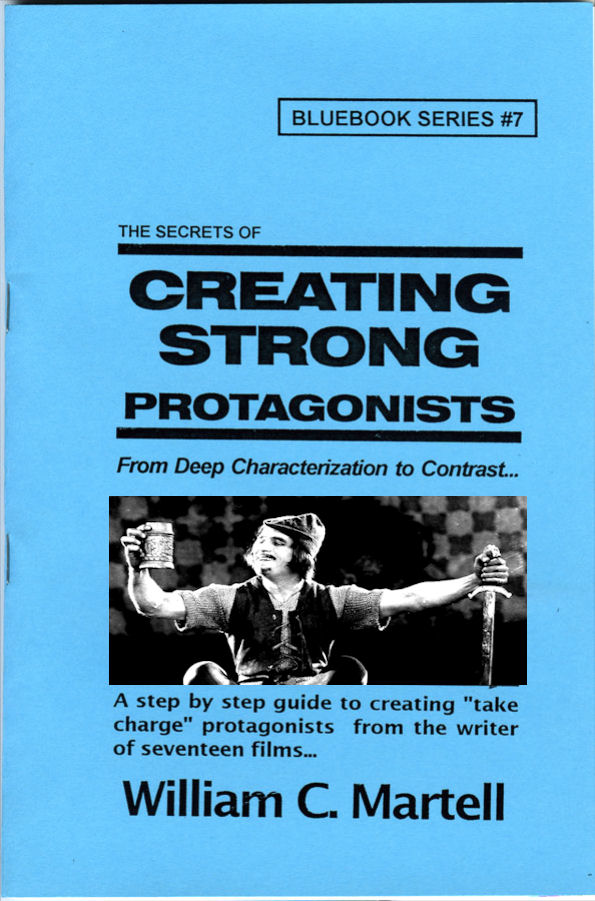
MOVIES ARE CHARACTERS!
*** CREATING STRONG PROTAGONISTS ***
Expanded version with more ways to create interesting protagonists! A step-by-step guide to creating "take charge" protagonists. Screenplays are about characters in conflict... characters in emotional turmoil... Strong three dimensional protagonists who can find solutions to their problems in 110 pages. But how do you create characters like this? How do you turn words into flesh and blood? Character issues, Knowing Who Is The Boss, Tapping into YOUR fears, The Naked Character, Pulp Friction, Man With A Plan, Character Arcs, Avoiding Cliche People, Deep Characterization, Problem Protagonists, 12 Ways To Create Likable Protagonists (even if they are criminals), Active vs. Reactive, The Third Dimension In Character, Relationships, Ensemble Scripts, and much, much more. Print version is 48 pages, Kindle version is once again around 205 pages!
ONLY $4.99 - Kindle Version
I WRITE PICTURES!
*** VISUAL STORYTELLING *** - For Kindle! (exclusive)
Show Don't Tell - but *how* do you do that? Here are techniques to tell stories visually! Using Oscar Winning Films and Oscar Nominated Films as our primary examples: from the first Best Picture Winner "Sunrise" (1927) to the Oscar Nominated "The Artist" (which takes place in 1927) with stops along the way Pixar's "Up" and Best Original Screenplay Winner "Breaking Away" (a small indie style drama - told visually) as well as "Witness" and other Oscar Winners as examples... plus RISE OF THE PLANET OF THE APES. Print version is 48 pages, Kindle version is over 200 pages!
ONLY $4.99 - Kindle Version
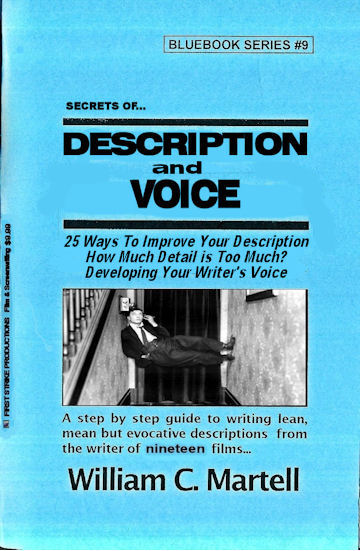
*** DESCRIPTION & VOICE ***
IS HALF OF YOUR STORY IN TROUBLE?
Most screenplays are about a 50/50 split between dialogue and description - which means your description is just as important as your dialogue. It just gets less press because the audience never sees it, the same reason why screenwriters get less press than movie stars. But your story will never get to the audience until readers and development executives read your script... so it is a very important factor. Until the movie is made the screenplay is the movie and must be just as exciting as the movie. So how do you make your screenplay exciting to read? Description is important in a novel as well, and the “audience” does read it... how do we write riveting description?
Only $4.99 Kindle version
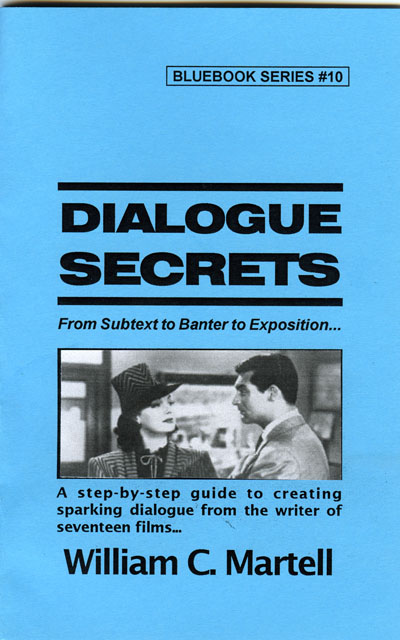
PRO DIALOGUE TECHNIQUES!
*** DIALOGUE SECRETS ***
Expanded version with more ways to create interesting dialogue! How to remove bad dialogue (and what *is* bad dialogue), First Hand Dialogue, Awful Exposition, Realism, 50 Professional Dialogue Techniques you can use *today*, Subtext, Subtitles, Humor, Sizzling Banter, *Anti-Dialogue*, Speeches, and more. Tools you can use to make your dialogue sizzle! Special sections that use dialogue examples from movies as diverse as "Bringing Up Baby", "Psycho", "Double Indemnity", "Notorious", the Oscar nominated "You Can Count On Me", "His Girl Friday", and many more! Print version is 48 pages, Kindle version is over 175 pages!
Only $4.99 - Kindle Version
NO KINDLE REQUIRED! Get the *free* app (any device, except your Mr. Coffee) on the order page on Amazon!

WHAT IS A SCENE?
*** SCENE SECRETS ***
What is a scene and how many you will need? The difference between scenes and sluglines. Put your scenes on trial for their lives! Using "Jaws" we'll look at beats within a scene. Scene DNA. Creating set pieces and high concept scenes. A famous director talks about creating memorable scenes. 12 ways to create new scenes. Creating unexpected scenes. Use dramatic tension to supercharge your scenes. Plants and payoffs in scenes. Plus transitions and buttons and the all important "flow"... and more! Over 65,000 words! Print version was 48 pages, Kindle version is around 210 pages!
Only $4.99 - Kindle version
SUBPLOTS?
*** SUPPORTING CHARACTER SECRETS ***
Expanded version with more techniques to flesh out your Supporting Characters and make them individuals. Using the hit movie BRIDESMAIDS as well as other comedies like THE HANGOVER and TED and HIGH FIDELITY and
40 YEAR OLD VIRGIN and many other examples we look at ways to make your Supporting Characters come alive on the page.
Print version was 48 pages, Kindle version is around 170 pages!
ONLY $4.99 - Kindle version
ACT TWO SOLUTIONS!
*** ACT TWO SECRETS ***
Expanded version with more techniques to help you through the desert of Act Two! Subjects Include: What Is Act Two? Inside Moves, The 2 Ps: Purpose & Pacing, The 4Ds: Dilemma, Denial, Drama and Decision, Momentum, the Two Act Twos, Subplot Prisms, Deadlines, Drive, Levels Of Conflict, Escalation, When Act Two Begins and When Act Two Ends, Scene Order, Bite Sized Pieces, Common Act Two Issues, Plot Devices For Act Two, and dozens of others. Over 67,000 words (that’s well over 200 pages) of tools and techniques to get you through the desert of Act Two alive!
Print version was 48 pages, Kindle version is well over 200 pages!
ONLY $4.99 - Kindle version
Can You Make It bigger?
***BLOCKBUSTERS (and BEACH READS) ***
Thinking about writing a big Disaster Movie? An Historical Epic? An Epic Adventure Film? Or maybe you like Gladiator Movies? This book looks at writing Blockbusters and those Big Fat Beach Read novels - anything epic! Usng movies like JAWS, POSEIDON ADVENTURE, LAWRENCE OF ARABIA, THE GUNS OF NAVARONE, and those MARVEL and FAST & FURIOUS flicks as examples. What *is* a Blockbuster? 107 years of Blockbuster history! Blockbuster Characters. Blockbuster Story Types! Why modern Blockbusters are soap operas! Social Issues in Blcokbusters? Big Emotions! Keeping All Of Those Characters Distinctive! How to avoid the Big problems found in Big Movies and books! More! If you are writing a Big Event Movie or a Big Fat Novel, there are tips and techniques to help you!
ONLY $4.99 - Kindle Version
NO KINDLE REQUIRED! Get the *free* app (any device, except your Mr. Coffee) on the order page on Amazon!
All About Rewrites!
*** REWRITES Blue Book! ***
When You Finish Your Screenplay Or Novel...
The Rewrites Begin!
The end is just the beginning! You’ve finished your story, but now the rewriting begins! This 405 page book
shows you how to rewrite your screenplay or novel to perfection. Everything from Character Consistency to
Shoeboxing to How To Give And Receive Notes to 15 Solutions If Your Script’s Too Long! and 15 Solutions
If Your Script’s Too Short! to Finding The Cause Of A Story Problem to Good Notes Vs. Bad Notes to Finding
Beta Readers to Avoiding Predictability to Learning To Be Objective About Your Work to Script Killer Notes and
Notes From Idiots to Production Rewrites and What The Page Colors Mean? and a Complete Rewrite Checklist!
The complete book on Rewriting Your Story!
Only $4.99 - Kindle Version

Want To Look Like An Expert?
*** RESEARCH & WORLD BUILDING BUILDING! ***
Using movie examples like TOP GUN, HUNT FOR RED OCTOBER, BLUE CRUSH, ADVENTURE LAND, several of my produced films,
JOHN WICK, the novels of Donald E. Westlake and Thomas B. Dewey, SPY KIDS, the LORD OF THE RINGS movies, SOYLENT GREEN
(which takes place in the far off future of 2022), and many others we will look at researching stories and creating worlds.
The 8 Types Of Research, the 10 Types Of Information To Look For, 12 Important Elements Of World Building. Plus chapters on How
To Rob A Bank and Commit Murder And Get Away With It for those of you interested in crime fiction, and Researching The Future
for those writing science fiction, and Levels Of Reality if you are writing about a version of the real world.
Only $4.99 - Kindle Version
All About LOGLINES, TREATMENTS, and PITCHING!
*** LOGLINES, TREATMENTS, and PITCHING! ***
You have written a brilliant 110 page screenplay, but how do you get anyone to read it? You need to distill
it down into some form of verbal moonshine or story rocket fuel that will ignite that bored development executive
or manager or agent and get them to request your screenplay. But how do you shrink those 110 pages into a 25
word logline or a 2 minute elevator pitch or a one page synopsis or a short paragraph? This 100,000 word book
shows you how! Everything you need to know! From common logline mistakes (and how to solve them) to how
your pitch can reveal story problems to the 4 types of pitches!
ONLY $4.99! - Kindle version.
READY TO BREAK IN?
*** BREAKING IN BLUE BOOK ***
Should really be called the BUSINESS BLUE BOOK because it covers almost everything you will need to
know for your screenwriting career: from thinking like a producer and learning to speak their language,
to query letters and finding a manager or agent, to making connections (at home and in Hollywood) and
networking, to the different kinds of meetings you are will have at Studios, to the difference between
a producer and a studio, to landing an assignment at that meeting and what is required of you when you
are working under contract, to contracts and options and lawyers and... when to run from a deal!
Information you can use *now* to move your career forward! It's all here in the Biggest Blue Book yet!
Only $4.99 - Kindle version.