FRIDAY'S SCRIPT TIP:
SYMBOLIC CHARACTERS
Film is a visual medium, a *dramatic* medium, and that requires conflict that we can
see. If we look at the movies playing this weekend we see a bunch of physical conflict -
from FANTASTIC BEASTS to BAD SANTA 2. But what should
we do when we have a story where the conflict is more internal and emotional? Well,
the first thing I'd suggest is to write it as a novel.

If I were to make a list of top 5 internal conflict movies of all time, HIGH FIDELITY
would be on it. HIGH FIDELITY began as a novel by Nick Hornby, but there are lessons
we can learn from the adaptation... methods of dramatizing internal conflict so that it
can be seen on the screen. First - the movie does something completely unusual. It's
not Voice Over, it's not Narrated, the protagonist actually talks to the audience
throughout the film. It's as if we're his best friend, or maybe his shrink. He spends the
whole film talking to us - even when other characters are present. It's not a Woody
Allen aside - it's the whole danged film! Though this gives us a way to know what the
protagonist is thinking, it isn't *dramatic* and film is a dramatic medium. See, we need a
way to *show* that internal conflict - to turn thoughts into something concrete.
HIGH FIDELITY is about a typical Hornby man-child struggling with responsibility.
Society wants Rob (John Cusack) to grow up - to put on a suit and tie and get a real job
- but he just wants to run his little Chicago record store. Champion Records specializes
in *vinyl* - because records have a more realistic sound quality than CDS. Rob loves
making Top 5 Lists and compilation tapes of *his* favorite songs to give to people. He
is the king of his little universe instead of participating in everybody else's universe.
"You guys are snobs!" a customer tells him. "You're totally elitists. You feel like the
unappreciated scholars, so you shit on the people who know less than you." "Which is
everybody," Rob answers. At Champion Records Rob is king - no reason to join society
when you're king, right? Rob's own mother thinks it's time for him to find a real job and
grow up - but Rob is happy just the way he is...
Until his girlfriend Laura (Iben Hjejle) pulls the plug on his existence and moves out.

Now Rob is going through one of those What Does It All Mean? things - reassessing his
life. He's broken hearted and depressed - but both of those are *internal* conflicts. Why
does he have such bad luck with women? Why is his life in constant turmoil? The
struggle is going on inside Rob, but we can't see that and film is a visual medium. So
we need to find ways to dramatize that conflict - to externalize it. On film, if we can't see
the conflict, it doesn't exist. So all of the characters in the script end up symbolizing
different aspects of the conflict within. You MUST have a conflict we can SEE in your
script. You MUST figure out ways to SHOW THE STRUGGLE. That means you need to
DRAMATIZE emotional conflict - to turn what happens in a character's heart and mind
into actions (and interactions with characters) that demonstrate this emotional conflict.
The best way to do that is to create characters which are symbols for Rob's problems.
CONTRAST CHARACTERS
The reason why Laura left him was because he's self-centered and refuses to grow up.
He's irresponsible. I've done tips in the past on contrast, and that's the tool we're going
to use to illuminate these problems within Rob. Laura didn't just leave Rob, she left him
for another man - Ian (Tim Robbins). Ian is a symbolic antagonist - he has all of the
qualities that Rob is lacking. Ian is a caring, nurturing therapist who cooks and provides
a shoulder for Laura to cry on. He's understanding, he's mature, he has a real job. Ian
used to live in the apartment above Rob & Laura, but he's since moved into a much
nicer apartment... which is where Laura goes to when she moves out of Rob's place.
After Laura leaves Rob, he embarks on a massive project - reorganizing his record
collection. Not alphabetically, not by year, he's organizing it "autobiographically" - based
on when *he* first heard the song. Talk about self-centered!

On film, you have to find ways to SHOW THE CONFLICT - so "man against himself"
conflicts won't work on their own. You need to have something physical the protagonist
can struggle with - that may be a "personification" of the conflict like Ian. He's a
symbolic antagonist. The reason why Laura moved out is what Rob *isn't* - but you
can't show what a character *isn't* - so you create a character who *is* those things.
Instead of Laura just moving out, she moves in with Ian (the anti-Rob).
Laura makes $60 thousand a year - she has a grown up law job. Ian is a therapist who
makes enough to move into a better neighborhood. Rob's record store is so successful
that he has to borrow $5 thousand from Laura and hasn't been able to pay it back.
Ian is a symbol of what Laura wants Rob to become.... just without the ponytail and
karate class pictures. Even in though Ian is in very few scenes, his *character* is
present from the very beginning. He is Rob's rival for Laura's love. Ian is all of the
things that Rob hates - because they are the changes Rob *knows* he needs to make
in himself. He's fighting those changes... and he's fighting Ian for Laura's love. If your
hero's character arc is to grow up you need someone who *has* grown up so that we
can see the struggle. Rob is in a battle with Ian for Laura's love. Remove Ian and how
can we see the battle?
MIRROR CHARACTERS
Another method would be to have a mirror character - someone else who has the exact
same emotional problems as Rob. You know how we can't stand people who have the
same flaws as we have? Mirror characters are a way for Rob to struggle with his
surrogate self and come to realize his own faults.
Rob has two connected internal problems - his relationships with women and his anti-social attitude. Both are symptoms of his refusal to grow up. In order to create a way for
Rob to struggles with these two aspects of himself, we give him a pair of employees.
Dick (Todd Louiso) is shy and paranoid around women. He is afraid of becoming
involved in a relationship for fear that he'll get hurt. He mirrors Rob's relationship
problems - his broken heart, his fear of being hurt in a relationship, and his weird
paranoia that he's just not worthy of any of the women he's gone out with. Though we
get to see this aspect of Rob first hand in his flashback relationship with Charlie
(Catherine Zeta Jones), the character of Dick allows us a reference point throughout
the film.

Barry (Jack Black) insults customers, comes to work late and is fun and totally
immature. Barry is about as anti-social as you can get. He's an exaggeration of Rob's
flaws. Rob is a music snob - Barry actually chases off customers who don't have his
taste. Rob isn't ambitious enough to change his life, Barry isn't even ambitious enough
to show up at his slacker job on time. Barry has a dream of fronting a band - but is
afraid to do anything about it. He's rather be a minimum wage slave than take a chance
on doing something better. Those are all Rob's flaws! As Rob struggles to turn Barry
into a more responsible employee, he's really struggling with his own flaws. Can he see
himself from Laura's and realize that he needs to mature?
Mirror characters can work two ways - you can use them as the unchanging "control" in
order to show how your protagonist is changing... or you can have them change in order
to show how your protagonist is stuck in a rut. HIGH FIDELITY uses the mirror
characters as a catalyst for Rob's change. All three are stuck in the same rut, stuck in
the same store... but Dick and Barry begin to mature - leaving Rob behind.
Dick forces himself to overcome his fears of relationships by asking out Anna (Sara
Gilbert), a customer who likes the same music as he does. Barry puts his anti-social
behavior on hold long enough to talk to a musician about forming a band. Up until this
point he has insulted any musician who approached him. When he stops being anti-social,
Barry lowers his walls of self defense and is able to access his dreams. This is
the lesson that Rob needs to learn.
There's a great scene in the movie where Rob suggests the three of them go out to a
club, but Barry says he can't - he's got to write lyrics for his band, and Dick says he
can't - he's got a date with Anna. Rob is left alone in his store while his mirror
characters move on with their lives. This scene ends with a great moment - as Rob is
locking up he sees Dick and Anna across the street kissing. Talk about rubbing it in!
Rob realizes what he doesn't have by seeing his mirror character obtain it. That acts as
a catalyst - Rob realizes he must change in order to be happy. He must get over his
fear of relationships and lower his defensive walls and take a chance on his dream.
Rob has a Top 5 List of dream jobs - and two of the jobs are producing records.
Of course, he's stuck in a rut working at his record store. Producing records would involve
working with others, and he's too anti-social for that.

The next day he hears a music tape made by the skateboard kids who hang around
outside his store, likes what he hears, and goes out and signs them to his record label.
Record label? What record label? Rob has stopped being anti-social long enough to
figure out that he has the connections to start his own label. He's going to put out a CD
(not a vinyl album) and put his music knowledge to good use. Instead of just talking
about music, he's going to *do something*. This is the first step in Rob's maturing
process, which ends with him winning Laura back and asking if she'll marry him.
"I've started to make a tape in my head for Laura. Full of stuff *she'd* like. Full of stuff
that would make *her* happy. For the first time, I can sort of see how that's done." Rob
has been transformed rom a guy who only thinks about what is important to him into a
guy who thinks about what is important to others. He's learned what love really is... and
grown up. We SEE this happening through the use of symbolic characters.
Symbolic Antagonists - DIFFERENT than protagonist - contrast the protagonist to show
what they need to become, what they need to learn, or (sometimes) the protagonist's
attributes.
Mirror Characters - SIMILAR to protagonist - have exaggerated versions of the
protagonist's flaws, so that the protagonist has to deal with those flaws externally.
Sometimes a Mirror Character contains the protagonist's attributes, and can be used to
show the protagonist taking the wrong road and getting into trouble.
Symbolic Characters are a great way to take an internal struggle and dramatize it. To
take a "man against himself" conflict and turn it into situations where different aspects of
that self are represented by different characters - so that we can SEE the struggle.
This tip is about to be retired because it is a chapter in the Supporting Characters Blue Book!
Note: As an Amazon Associate I earn from qualifying purchases made from this website.
BRAND NEW!
How Do I do That?

101 SCREENWRITING ANSWERS Blue Book!
New to screenwriting? You probably have questions! How do I get an Agent? How do I write a phone conversation? Do I need a Mentor? What’s does VO and OC and OS mean? What is proper screenplay format? Should I use a pen name? Do I need to movie to Hollywood? What’s the difference between a Producer and a Production Manager, and which should I sell my script to? How do I write a Text Message? Should I Copyright or WGA register my script? Can I Direct or Star? How do I write an Improvised scene? Overcoming Writer’s Block? How do I write a Sex Scene? And many many more! This book has the answers to the 101 Most Asked Questions from new screenwriters! Plus a Glossary of terms so that you can sound like a pro! Everything you need to know to begin writing your screenplay!
All of the answers you need to know, from a working professional screenwriter with 20 produced films and a new movie made for a major streaming service in 2023!
Only $4.99
NO KINDLE REQUIRED! Get the *free* app (any device, except your Mr. Coffee) on the order page on Amazon!
Making Your Own Movie?
WRITE IT: FILM IT BOOK!
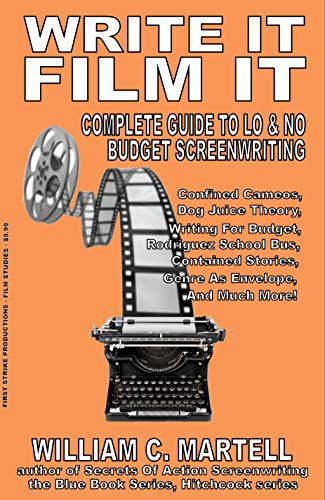
Making Your Own Movie?
Writing An Indie Film?
Writing A Low Budget Genre Script To Sell?
Writing A Made For TV Holiday Movie?
You will be writing for BUDGET. On a standard spec screenplay, you don’t have to think about budget, but these types of screenplays writing with budget in mind is critical!
If you are making your own movie, budget, is even more important - and you need to think about budget *before* you write your screenplay... or you will end up with a script that you can’t afford to make (or is a struggle to make). Everyone is making their own films these days, and even if you have done it before there are lots of great techniques in this book to get more money on screen - for less money! You can make a film that looks like it cost millions for pocket change.
344 Pages - ONLY: $7.99!
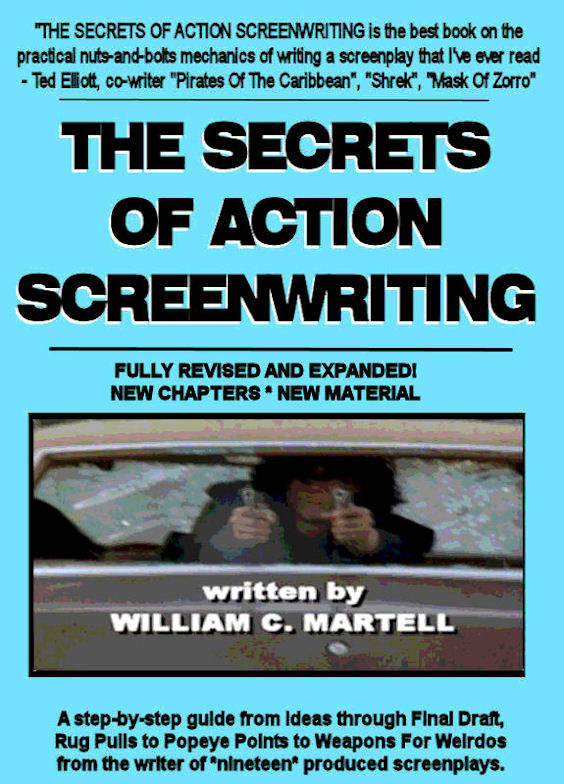
THE BOOK THAT STARTED IT ALL!
*** THE SECRETS OF ACTION SCREENWRITING *** - For Kindle!
*** THE SECRETS OF ACTION SCREENWRITING *** - For Nook!
Why pay $510 for a used version of the 240 page 2000 version that used to retail for $21.95? (check it out!) when
you can get the NEW EXPANDED VERSION - over 500 pages - for just $9.99? New chapters, New examples, New techniques!
"SECRETS OF ACTION SCREENWRITING is the
best book on the practical nuts-and-bolts mechanics of writing a screenplay I've ever read."
- Ted Elliott, co-writer of MASK OF ZORRO, SHREK, PIRATES OF THE CARIBBEAN and the sequels (with Terry Rossio). (ie; 4 of the top 20 Box Office Hits Of ALL TIME.)
Only $9.99 - and no postage!
Tips FAQ

THE BLUE BOOKS!
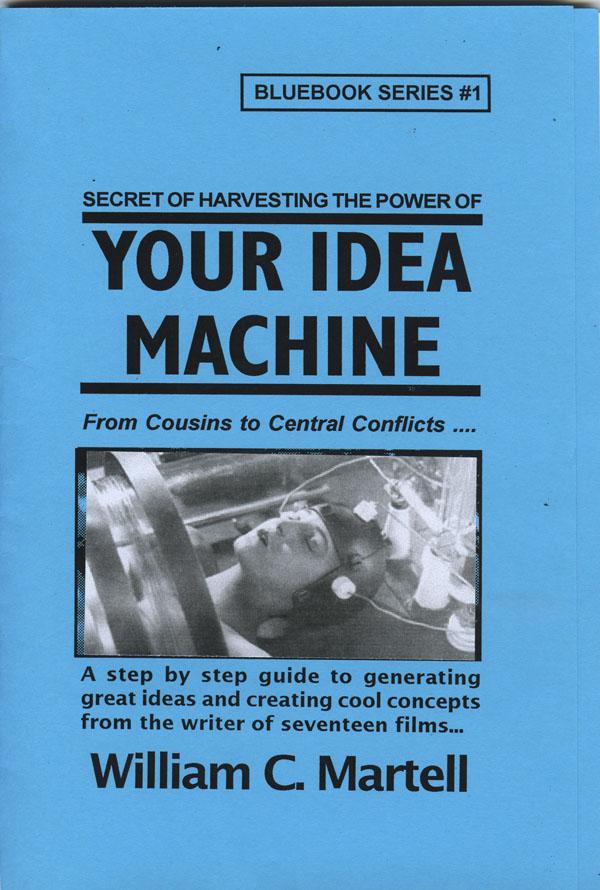
FIND A GREAT IDEA!
*** YOUR IDEA MACHINE ***
Expanded version with more ways to find great ideas! Your screenplay is going to begin with an idea. There are good ideas and bad ideas and commercial ideas and personal ideas. But where do you find ideas in the first place? This handbook explores different methods for finding or generating ideas, and combining those ideas into concepts that sell. The Idea Bank, Fifteen Places To Find Ideas, Good Ideas And Bad Ideas, Ideas From Locations And Elements, Keeping Track Of Your Ideas, Idea Theft - What Can You Do? Weird Ways To Connect Ideas, Combing Ideas To Create Concepts, High Concepts - What Are They? Creating The Killer Concept, Substitution - Lion Tamers & Hitmen, Creating Blockbuster Concepts, Magnification And The Matrix, Conflict Within Concept, Concepts With Visual Conflict, Avoiding Episodic Concepts, much more! Print version is 48 pages, Kindle version is over 175 pages!
Only $4.99 - Kindle Version
FIGURE OUT YOUR STORY!
*** OUTLINES & THE THEMATIC ***
Your story is like a road trip... but where are you going? What's the best route to get there? What are the best sights to see along the way? Just as you plan a vacation instead of just jump in the car and start driving, it's a good idea to plan your story. An artist does sketches before breaking out the oils, so why shouldn't a writer do the same? This Blue Book looks at various outlining methods used by professional screenwriters like Wesley Strick, Paul Schrader, John August, and others... as well as a guest chapter on novel outlines. Plus a whole section on the Thematic Method of generating scenes and characters and other elements that will be part of your outline. The three stages of writing are: Pre-writing, Writing, and Rewriting... this book looks at that first stage and how to use it to improve your screenplays and novels.
Only $4.99 - Kindle Version
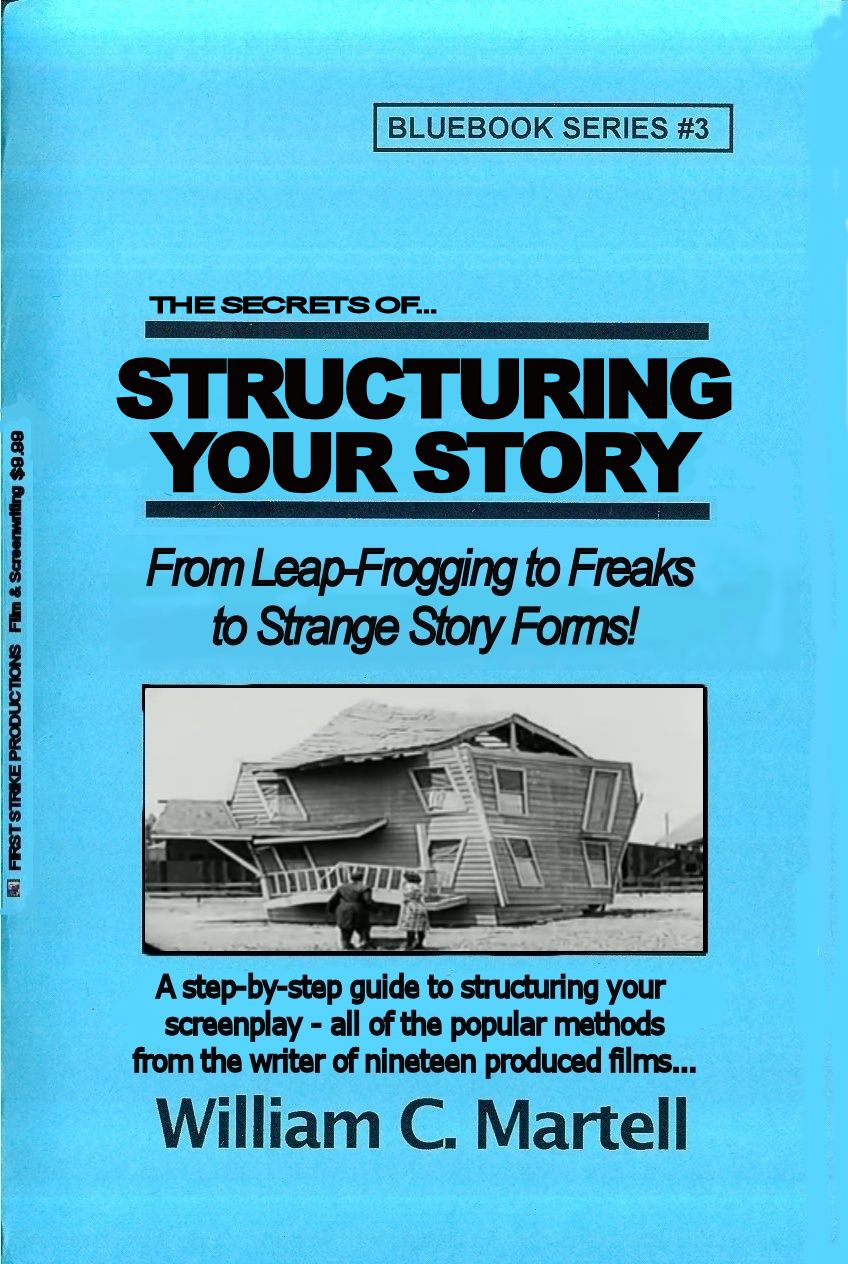
GOT STRUCTURE?!
*** STRUCTURING YOUR STORY ***
William Goldman says the most important single element of any screenplay is structure. It’s the skeleton under the flesh and blood of your story. Without it, you have a spineless, formless, mess... a slug! How do you make sure your structure is strong enough to support your story? How do you prevent your story from becoming a slug? This Blue Book explores different types of popular structures from the basic three act structure to more obscure methods like leap-frogging. We also look at structure as a verb as well as a noun, and techniques for structuring your story for maximum emotional impact. Most of the other books just look at *structure* and ignore the art of *structuring* your story. Techniques to make your story a page turner... instead of a slug!
Only $4.99 - Kindle Version
STORY: WELL TOLD!
*** STORY: WELL TOLD ***
This book takes you step-by-step through the construction of a story... and how to tell a story well, why Story always starts with character... but ISN'T character, Breaking Your Story, Irony, Planting Information, Evolving Story, Leaving No Dramatic Stone Unturned, The Three Greek Unities, The Importance Of Stakes, The Thematic Method, and how to create personal stories with blockbuster potential. Ready to tell a story?
Print version was 48 pages, Kindle version is over 85,000 words - 251 pages!
Only $4.99 - Kindle Version
HOW DO I DO THAT?
*** 101 SCREENWRITING ANSWERS ***
New to screenwriting? You probably have questions! How do I get an Agent? How do I write a phone conversation?
Do I need a Mentor? What’s does VO and OC and OS mean? What is proper screenplay format?
Should I use a pen name? Do I need to movie to Hollywood? What’s the difference between a
Producer and a Production Manager, and which should I sell my script to? How do I write a Text Message?
Should I Copyright or WGA register my script? Can I Direct or Star? How do I write an Improvised scene?
Overcoming Writer’s Block? How do I write a Sex Scene? And many many more! This book has the answers to
the 101 Most Asked Questions from new screenwriters! Plus a Glossary of terms so that you can sound like a pro!
Everything you need to know to begin writing your screenplay!
Only $4.99 - Kindle Version
NO KINDLE REQUIRED! Get the *free* app (any device, except your Mr. Coffee) on the order page on Amazon!

START STRONG!
*** HOOK 'EM IN TEN ***
Your story doesn't get a second chance to make a great first impression, and this book shows you a
bunch of techniques on how to do that. From the 12 Basic Ways To Begin Your Story, to the 3 Stars Of
Your First Scene (at least one must be present) to World Building, Title Crawls, Backstory, Starting
Late, Teasers and Pre Title Sequences, Establishing Theme & Motifs (using GODFATHER PART 2), Five Critical
Elements, Setting Up The Rest Of The Story (with GODFATHER), and much more! With hundreds of examples
ranging from Oscar winners to classic films like CASABLANCA to some of my produced films (because
I know exactly why I wrote the scripts that way). Biggest Blue Book yet!
Print version was 48 pages, Kindle version is over 100,000 words - 312 pages!
Only $4.99 - Kindle Version
MOVIES ARE CHARACTERS!
*** CREATING STRONG PROTAGONISTS ***
Expanded version with more ways to create interesting protagonists! A step-by-step guide to creating "take charge" protagonists. Screenplays are about characters in conflict... characters in emotional turmoil... Strong three dimensional protagonists who can find solutions to their problems in 110 pages. But how do you create characters like this? How do you turn words into flesh and blood? Character issues, Knowing Who Is The Boss, Tapping into YOUR fears, The Naked Character, Pulp Friction, Man With A Plan, Character Arcs, Avoiding Cliche People, Deep Characterization, Problem Protagonists, 12 Ways To Create Likable Protagonists (even if they are criminals), Active vs. Reactive, The Third Dimension In Character, Relationships, Ensemble Scripts, and much, much more. Print version is 48 pages, Kindle version is once again around 205 pages!
ONLY $4.99 - Kindle Version
I WRITE PICTURES!
*** VISUAL STORYTELLING *** - For Kindle! (exclusive)
Show Don't Tell - but *how* do you do that? Here are techniques to tell stories visually! Using Oscar Winning Films and Oscar Nominated Films as our primary examples: from the first Best Picture Winner "Sunrise" (1927) to the Oscar Nominated "The Artist" (which takes place in 1927) with stops along the way Pixar's "Up" and Best Original Screenplay Winner "Breaking Away" (a small indie style drama - told visually) as well as "Witness" and other Oscar Winners as examples... plus RISE OF THE PLANET OF THE APES. Print version is 48 pages, Kindle version is over 200 pages!
ONLY $4.99 - Kindle Version
*** DESCRIPTION & VOICE ***
IS HALF OF YOUR STORY IN TROUBLE?
Most screenplays are about a 50/50 split between dialogue and description - which means your description is just as important as your dialogue. It just gets less press because the audience never sees it, the same reason why screenwriters get less press than movie stars. But your story will never get to the audience until readers and development executives read your script... so it is a very important factor. Until the movie is made the screenplay is the movie and must be just as exciting as the movie. So how do you make your screenplay exciting to read? Description is important in a novel as well, and the “audience” does read it... how do we write riveting description?
Only $4.99 Kindle version
PRO DIALOGUE TECHNIQUES!
*** DIALOGUE SECRETS ***
Expanded version with more ways to create interesting dialogue! How to remove bad dialogue (and what *is* bad dialogue), First Hand Dialogue, Awful Exposition, Realism, 50 Professional Dialogue Techniques you can use *today*, Subtext, Subtitles, Humor, Sizzling Banter, *Anti-Dialogue*, Speeches, and more. Tools you can use to make your dialogue sizzle! Special sections that use dialogue examples from movies as diverse as "Bringing Up Baby", "Psycho", "Double Indemnity", "Notorious", the Oscar nominated "You Can Count On Me", "His Girl Friday", and many more! Print version is 48 pages, Kindle version is over 175 pages!
Only $4.99 - Kindle Version
NO KINDLE REQUIRED! Get the *free* app (any device, except your Mr. Coffee) on the order page on Amazon!

WHAT IS A SCENE?
*** SCENE SECRETS ***
What is a scene and how many you will need? The difference between scenes and sluglines. Put your scenes on trial for their lives! Using "Jaws" we'll look at beats within a scene. Scene DNA. Creating set pieces and high concept scenes. A famous director talks about creating memorable scenes. 12 ways to create new scenes. Creating unexpected scenes. Use dramatic tension to supercharge your scenes. Plants and payoffs in scenes. Plus transitions and buttons and the all important "flow"... and more! Over 65,000 words! Print version was 48 pages, Kindle version is around 210 pages!
Only $4.99 - Kindle version
SUBPLOTS?
*** SUPPORTING CHARACTER SECRETS ***
Expanded version with more techniques to flesh out your Supporting Characters and make them individuals. Using the hit movie BRIDESMAIDS as well as other comedies like THE HANGOVER and TED and HIGH FIDELITY and
40 YEAR OLD VIRGIN and many other examples we look at ways to make your Supporting Characters come alive on the page.
Print version was 48 pages, Kindle version is around 170 pages!
ONLY $4.99 - Kindle version
ACT TWO SOLUTIONS!
*** ACT TWO SECRETS ***
Expanded version with more techniques to help you through the desert of Act Two! Subjects Include: What Is Act Two? Inside Moves, The 2 Ps: Purpose & Pacing, The 4Ds: Dilemma, Denial, Drama and Decision, Momentum, the Two Act Twos, Subplot Prisms, Deadlines, Drive, Levels Of Conflict, Escalation, When Act Two Begins and When Act Two Ends, Scene Order, Bite Sized Pieces, Common Act Two Issues, Plot Devices For Act Two, and dozens of others. Over 67,000 words (that’s well over 200 pages) of tools and techniques to get you through the desert of Act Two alive!
Print version was 48 pages, Kindle version is well over 200 pages!
ONLY $4.99 - Kindle version
Can You Make It bigger?
***BLOCKBUSTERS (and BEACH READS) ***
Thinking about writing a big Disaster Movie? An Historical Epic? An Epic Adventure Film? Or maybe you like Gladiator Movies? This book looks at writing Blockbusters and those Big Fat Beach Read novels - anything epic! Usng movies like JAWS, POSEIDON ADVENTURE, LAWRENCE OF ARABIA, THE GUNS OF NAVARONE, and those MARVEL and FAST & FURIOUS flicks as examples. What *is* a Blockbuster? 107 years of Blockbuster history! Blockbuster Characters. Blockbuster Story Types! Why modern Blockbusters are soap operas! Social Issues in Blcokbusters? Big Emotions! Keeping All Of Those Characters Distinctive! How to avoid the Big problems found in Big Movies and books! More! If you are writing a Big Event Movie or a Big Fat Novel, there are tips and techniques to help you!
ONLY $4.99 - Kindle Version
NO KINDLE REQUIRED! Get the *free* app (any device, except your Mr. Coffee) on the order page on Amazon!
All About Rewrites!
*** REWRITES Blue Book! ***
When You Finish Your Screenplay Or Novel...
The Rewrites Begin!
The end is just the beginning! You’ve finished your story, but now the rewriting begins! This 405 page book
shows you how to rewrite your screenplay or novel to perfection. Everything from Character Consistency to
Shoeboxing to How To Give And Receive Notes to 15 Solutions If Your Script’s Too Long! and 15 Solutions
If Your Script’s Too Short! to Finding The Cause Of A Story Problem to Good Notes Vs. Bad Notes to Finding
Beta Readers to Avoiding Predictability to Learning To Be Objective About Your Work to Script Killer Notes and
Notes From Idiots to Production Rewrites and What The Page Colors Mean? and a Complete Rewrite Checklist!
The complete book on Rewriting Your Story!
Only $4.99 - Kindle Version

Want To Look Like An Expert?
*** RESEARCH & WORLD BUILDING BUILDING! ***
Using movie examples like TOP GUN, HUNT FOR RED OCTOBER, BLUE CRUSH, ADVENTURE LAND, several of my produced films,
JOHN WICK, the novels of Donald E. Westlake and Thomas B. Dewey, SPY KIDS, the LORD OF THE RINGS movies, SOYLENT GREEN
(which takes place in the far off future of 2022), and many others we will look at researching stories and creating worlds.
The 8 Types Of Research, the 10 Types Of Information To Look For, 12 Important Elements Of World Building. Plus chapters on How
To Rob A Bank and Commit Murder And Get Away With It for those of you interested in crime fiction, and Researching The Future
for those writing science fiction, and Levels Of Reality if you are writing about a version of the real world.
Only $4.99 - Kindle Version
All About LOGLINES, TREATMENTS, and PITCHING!
*** LOGLINES, TREATMENTS, and PITCHING! ***
You have written a brilliant 110 page screenplay, but how do you get anyone to read it? You need to distill
it down into some form of verbal moonshine or story rocket fuel that will ignite that bored development executive
or manager or agent and get them to request your screenplay. But how do you shrink those 110 pages into a 25
word logline or a 2 minute elevator pitch or a one page synopsis or a short paragraph? This 100,000 word book
shows you how! Everything you need to know! From common logline mistakes (and how to solve them) to how
your pitch can reveal story problems to the 4 types of pitches!
ONLY $4.99! - Kindle version.
READY TO BREAK IN?
*** BREAKING IN BLUE BOOK ***
Should really be called the BUSINESS BLUE BOOK because it covers almost everything you will need to
know for your screenwriting career: from thinking like a producer and learning to speak their language,
to query letters and finding a manager or agent, to making connections (at home and in Hollywood) and
networking, to the different kinds of meetings you are will have at Studios, to the difference between
a producer and a studio, to landing an assignment at that meeting and what is required of you when you
are working under contract, to contracts and options and lawyers and... when to run from a deal!
Information you can use *now* to move your career forward! It's all here in the Biggest Blue Book yet!
Only $4.99 - Kindle version.
STORY IN ACTION SERIES!

THE MISSION IMPOSSIBLE MOVIES
NEW: Updates On Films 7 & 8 Casting!
The First Six Movies analyzed! All of the mission tapes, all of the “that’s impossible!” set pieces and stunts, the cons and capers - and how these scenes work, the twists and double crosses, the tension and suspense (and how to generate it), the concept of each film as a stand alone with a different director calling the shots (broken in the sixth film), the gadgets, the masks, the stories, the co-stars and team members (one team member has been in every film), the stunts Tom Cruise actually did (and the ones he didn’t), and so much more! Over 120,000 words of fun info!
THE MISSION IMPOSSIBLE MOVIES - 347 Pages -
Only $3.99 ! - Kindle Version

*** THE BOURNE MOVIES
All five "Bourne" movies (including "Legacy" and it's potential sequels) - what are the techniques used to keep the characters and scenes exciting and involving? Reinventing the thriller genre...
or following the "formula"? Five films - each with an interesting experiment! A detailed analysis of each
of the films, the way these thrillers work... as well as a complete list of box office and critical
statistics for each film. This book is great for writers, directors, and just fans of the series.
Only $3.99 - Kindle version
Over 240 pages!
*** THE TERMINATOR MOVIES ***
He's back! The release of "Terminator: Dark Fate" is set to begin a new trilogy in
the Terminator story... 35 years after the first film was released. What draws us to these films about
a cybernetic organism from the future sent back in time? Why is there a new proposed trilogy every few
years? This book looks at all five Terminator movies from a story standpoint - what makes them work
(or not)? What are the techniques used to keep the characters and scenes exciting and involving? How
about those secret story details you may not have noticed? Containing a detailed analysis of each of
the five films so far, this book delves into the way these stories work... as well as a complete list of
box office and critical statistics for each film. This book is great for writers, directors, and just
fans of the series.
ONLY $3.99 - Kindle Version
HITCHCOCK FOR WRITERS!
Strange Structures!
*** HITCHCOCK: EXPERIMENTS IN TERROR! ***
Contained Thrillers like "Buried"? Serial Protagonists like "Place Beyond The Pines"? Multiple Connecting Stories like "Pulp Fiction"? Same Story Multiple Times like "Run, Lola, Run"?
HITCHCOCK DID IT FIRST!
This book focuses on 18 of Hitchcock's 52 films with wild cinema and story experiments which paved the way for modern films. Almost one hundred different experiments that you may think are recent cinema or story inventions... but some date back to Hitchcock's *silent* films! We'll examine these experiments and how they work. Great for film makers, screenwriters, film fans, producers and directors.
Only $5.99 - Kindle Version
LEARN SUSPENSE FROM THE MASTER!
*** HITCHCOCK: MASTERING SUSPENSE ***
Alfred Hitchcock, who directed 52 movies, was known as the *Master Of Suspense*; but what exactly is suspense and how can *we* master it? How does suspense work? How can *we* create “Hitchcockian” suspense scenes in our screenplays, novels, stories and films?
This book uses seventeen of Hitchcock’s films to show the difference between suspense and surprise, how to use “focus objects” to create suspense, the 20 iconic suspense scenes and situations, how plot twists work, using secrets for suspense, how to use Dread (the cousin of suspense) in horror stories, and dozens of other amazing storytelling lessons. From classics like “Strangers On A Train” and “The Birds” and “Vertigo” and “To Catch A Thief” to older films from the British period like “The 39 Steps” and “The Man Who Knew Too Much” to his hits from the silent era like “The Lodger” (about Jack The Ripper), we’ll look at all of the techniques to create suspense!
Only $5.99 - Kindle Version
FICTION
Featuring Shelly Steele !
*** THE SHOTGUN APPROACH ***
A Pop Star is murdered on the VIP floor of a luxury hotel by a shotgun blast to the face... completely ruining an original piece of art
on the wall behind him. Violent SFPD Homicide Inspector Shelly Steele must find the murderer... without killing anyone in the process.
That won't be easy! A locked room, A handful of clues. A chase and shootout on the hotel's fire stairs.
Who is the killer? His ex-Partner? His ex-Wife? His ex-Record Label Owner?
THE SHOTGUN APPROACH 105 pgs!
ONLY $.99 - Kindle Version
Featuring Smart & Final !
*** A FINE UPSTANDING CITIZEN ***
25 years ago Senator Milano killed a man. Now he's one of a dozen suspects in an information leak.
Being interrogated in the executive boardroom on the 30th floor of an office building...
The informant will not be leaving by the elevator. Can he solve the crime before they discover his secret?
Fnd the rat before the trap springs on him?
A FINE UPSTANDING CITIZEN (CRIME TIME THRILLER) 86 pgs!
ONLY $.99 - Kindle Version

Crime Time Thriller !
*** FOLLOWED HOME ***
Bowden knew the best place to find a victim is somewhere they feel safe. Diane Taylor would be his next victim...
It began with a car jacking at an upscale grocery store, but fresh out of prison Bowden decided to take everything -
forcing Diane to drive him her her luxury home. Trapped in her SUV with a violent man, can she find a way to turn the tables on him and survive?
FOLLOWED HOME (CRIME TIME THRILLER)
ONLY $.99 - Kindle Version

Featuring Smart & Final !
*** PRIME RATE ***
Chuck Skinner brought his father's failing butcher shop back into the black with the help of modern day cattle rustlers. Nice story if it ends there...
But now the head of the MaryAnn Mob of cattle rustlers suspects him of cooking his books, and has brought in an "accountant"
nicknamed Smart & Final... to hold him accountable. Can Chuck talk his way out of this?
PRIME RATE (CRIME TIME THRILLER)
ONLY $.99 - Kindle Version
MITCH ROBERTSON MYSTERIES

Mitch Robertson #1
*** THROUGH THE RINGER ***
Screenwriter Mitch Robertson just wants to sell a script, but ends up solving the mystery of a whiz kid writer whose new script stinks.
From an upscale vodka bar in Beverly Hills to the Writer's Guild Library to an old mansion in the woodsy Brentwood district, Mitch follows
the clues to uncover the secret of the hot new writer who has suddenly turned cold.
THROUGH THE RINGER
ONLY $.99 - Kindle Version
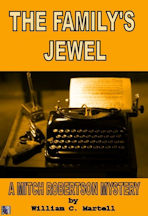
Mitch Robertson #2
*** THE FAMILY'S JEWEL ***
"The Presidential Suite of the Hollywood Hoover Hotel looked like a bloody battlefield: bodies everywhere, furniture broken, red liquid dripping from the walls, dead soldiers littering the elegant Berber rug as clouds of smoke overhead bounced between two air conditioning vents.
Mitch Robertson stepped over the body of an ex-child star turned sex tape star turned pop star and entered the room, spotted a gun on the floor and picked it up... careful not to spill his coffee with three pumps of mocha syrup from Penny’s Coffee Shop. That coffee was gold, the only thing keeping him going in this dazed state of wakefulness. The gun felt light. Holding it, he saw the silhouette of an 80s action star sitting sideways on a tipped over chair. Motionless. Was he dead? Mitch was still hung over from the Awards Party the night before, and wondered whether this was all some sort of crazy nightmare that he would wake up from... but when he tripped over the brown legs of a bottomless Superhero, flaccid junk encased in a condom but still wearing his mask, and hit the edge of the sofa, gun skittering and coffee spilling, he realized that it was all very real. What the hell had happened here?"
Short Novel. Only 99 cents! - Kindle Version
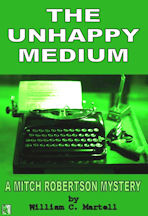
Mitch Robertson #3
***
THE UNHAPPY MEDIUM ***
When Warren Moultie, the "Psychic To The Stars", private files, with dirt on everyone in Hollywood, are stolen, Mitch must find them and the
thief before the blackmail begins! But when studios and movie stars and pop music stars and TV stars begin receiving demands for millions
typed by an ancient typewriter on cheap paper, the entire Entertainment Industry is depending on him. Who stole the files? The Psychic? His wife?
His mistress? One of his famous clients?
Novella. Only 99 cents! - Kindle Version